BOOTHBAY REGION HISTORICAL SOCIETY

P.O. Box 272,  72 Oak Street  Boothbay Harbor,  ME  04538-0272 
Tel: (207) 633-0820

Hours: Wednesdays through Saturdays, 10  a.m. to 2 p.m.

Review of Annual Meeting and talk

Web site contents - the latest newsletter is on-line


THE HISTORICAL SOCIETY

The Boothbay Region Historical Society is located at the 1874 Elizabeth F. Reed house (sketched above by Alden Stickney) and its grounds, Fullerton Park. Many of the furnishings in the house were Reed family heirlooms. The society has traditionally represented the three towns in the region: Boothbay, Boothbay Harbor, and Southport, though Southport is now ably represented by its own society.  It displays local historical mementos and houses documentary collections. The society is governed by a board of trustees and has a part-time director. It is supported by membership dues, book and map sales and donations. Among the benefits of membership are newsletters and a reduction in the cost of purchases. We encourage people to consider membership in the society and join the effort to preserve the past.

About the Society

ACTIVITIES

Some of the society's activities: year-round tours of the exhibits, talks and slide shows about local history, open houses and special events such as temporary exhibits or book signing parties. The society provides monthly articles on local historical matters to the local newspaper. Alternated between the articles are monthly photos with extended captions. Since 1984 the society has reprinted two classic town histories and has published four new books on Boothbay region history. It has also published monographs on various topics.

Society Events

EXHIBITS

The museum's seven display rooms contain artifacts and memorabilia that reflect the region's colonial and coastal origins. The Fresnel lens from the Ram Island Light in the front room catches the sun's rays and the imagination. Relics of bygone vessels - the ship's bell from the five-masted schooner the Courtney Houck and the wheel and compass from the ferry Richard T., later used on the excursion boat Holiday, are reminiscent of seagoing days. Lobstering and fishing are richly illustrated with pictures, boatmodels, nautical instruments, vintage traps and tools used in the trade. An elegant model of the Gulf of Maine shows varying depths of water and where fish were caught.

Tools tell the stories of early industries - a spokeshave for making barrels, saws and groovers for cutting ice, paraphernalia for making sails and milling equipment. Indian stone tools and arrowheads and prehistoric artifacts are evidence of life before the colonialists. Mingled throughout the rooms and halls are antique furnishings, china, paintings and photographs of long-gone buildings. Clothing from early times is displayed, along with a World War I uniform in mint condition. The collections are added to continually as descendants of early settlers empty their attics and bring in their treasures.

Society Events

RESEARCH and SERVICES

The society has many collections of local primary and secondary historical documents to help visitors research their fields of interest. The towns of Boothbay, Boothbay Harbor, and Southport are the principal areas represented in the archives.

The collections include:  

Copies of documents and photos may be obtained for a modest fee. Visitors are urged to undertake their own searches for information. However, extensive research can be performed for a reasonable fee by a local historian.

Research & Services

BOOTHBAY HISTORY

English fishermen settled on Damariscove Island off Boothbay and at Newagen in the early 1600s.  When hungry Pilgrims came east to buy food, they were generously supplied by Damariscove fishermen. These settlements prospered, exporting salt fish, timber and furs, until the Indian Wars wiped them out. Scotch-Irish families began to settle in the region in 1729. Subsistence farming and trade in lumber, firewood, hay and fish supported them.  In 1764 the settlement was incorporated as the town of Boothbay. During the Revolution and the War of 1812, Boothbay men served as soldiers, as seamen aboard privateers or as defense against marauding British ships. After the wars, Boothbay vessels fished on the offshore banks for cod and inshore for mackerel. 

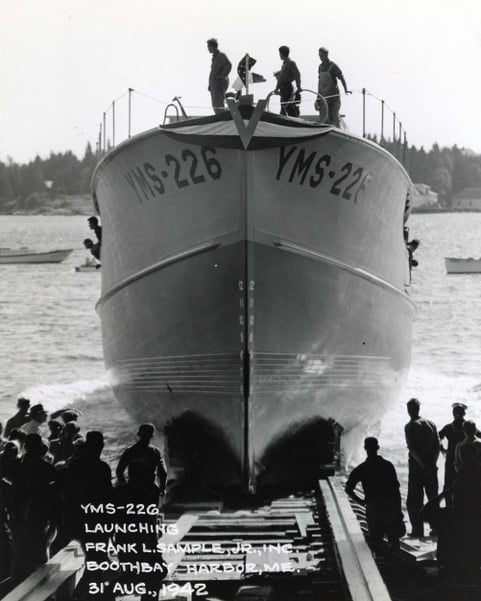
Shipbuilding, farming, ice-cutting and brick-making flourished. After the Civil War, regular steamer service brought vacationers to the region. Summer hotels and cottage colonies sprang up at Ocean Point, Newagen, Squirrel Island and elsewhere.  Fresh fish and lobsters were sent by steamer and rail to the Boston market. Boothbay-built schooners loaded with salt fish, bricks and ice returned with coal, ship timber and manufactured goods. During and after both World Wars, Boothbay shipyards built minesweepers and other government vessels. Recently overfishing has put many fisherman ashore, but lobstering flourishes. Boothbay yards now specialize in yachts, big steel fishing vessels, ferries and tugs. With lobstering, shipbuilding and tourism, the Boothbay region is a busy place in summer.

E-mail:

Due to the occasional technical difficulty associated with checking email, if we don't respond to you within a week, please write us again to be sure we get your message.  Thank you.

 
*Please Note: E-mail messages are checked on Wednesday, Thursday, & Friday between 10am-2pm.

~~~~~~~~~~~~~~~~~~~~~~~~~~~~~~~~~~~~~~~~~~~~~~~~~~~~~~~~~~~~~~~~~~~~~~~~~~~
The mission of the Boothbay Region Historical Society is to promote interest in the history of the Boothbay region and to preserve the region's history. The society is a non-profit membership 501(c)(3) organization.
~~~~~~~~~~~~~~~~~~~~~~~~~~~~~~~~~~~~~~~~~~~~~~~~~~~~~~~~~~~~~~~~~~~~~~~~~~~

Donated
by Great Works Internet

INFORMATION email: brhs@gwi.net

TABLE OF CONTENTS

_________ This site was last updated 09/01/08 . ____________

Home    Newsletter    Society Events    Research & Services   About the Society    Map    Membership    

Articles    Photos    Items for Sale    Board of Trustees